Top Stylist: "Balding Men Get Promoted. Thinning Women Get Passed Over. Here's The 60-Second Protocol Fortune 500 Women Are Quietly Using To Fight Back"
A veteran stylist and board-certified dermatologist reveal what 88,000 professional women — from Fortune 500 boardrooms to federal courtrooms — are quietly using every morning to reverse the hormonal hair loss the medical industry spent 50 years classifying as "cosmetic."
88,000 professional women. One 60-second morning protocol. One hormone nobody was blocking.
I'm about to say something that's going to make every HR department, every executive coach, and every dermatologist in America very uncomfortable.
My name is Lisa Renner. I've been a licensed stylist for 22 years. I specialize in fine and thinning hair. I've held more women's hair in my hands than I can count — somewhere north of 3,000 heads over two decades behind the chair. I know what healthy hair feels like. I know what damaged hair feels like. And I know what disappearing hair feels like — because over the past five years, that's what's been walking into my salon.
But here's the part nobody wants to say out loud.
The women who cry hardest in my chair aren't who you'd expect. They're the ones in suits. They're the ones with calendars full of board meetings. They're the ones who built careers on being taken seriously — and can feel that being quietly stripped from them one strand at a time.
They're senior partners at law firms. Surgeons. Fortune 500 VPs. Women who argue cases in federal court and lead teams of 40 and close eight-figure deals — and who schedule their hair appointments at 6:00 AM so nobody in their industry will see them mid-color.
And I'm done staying quiet about what's actually happening to them. Because here's the truth nobody is willing to put in print:
Balding men get called distinguished. Thinning women get called tired.
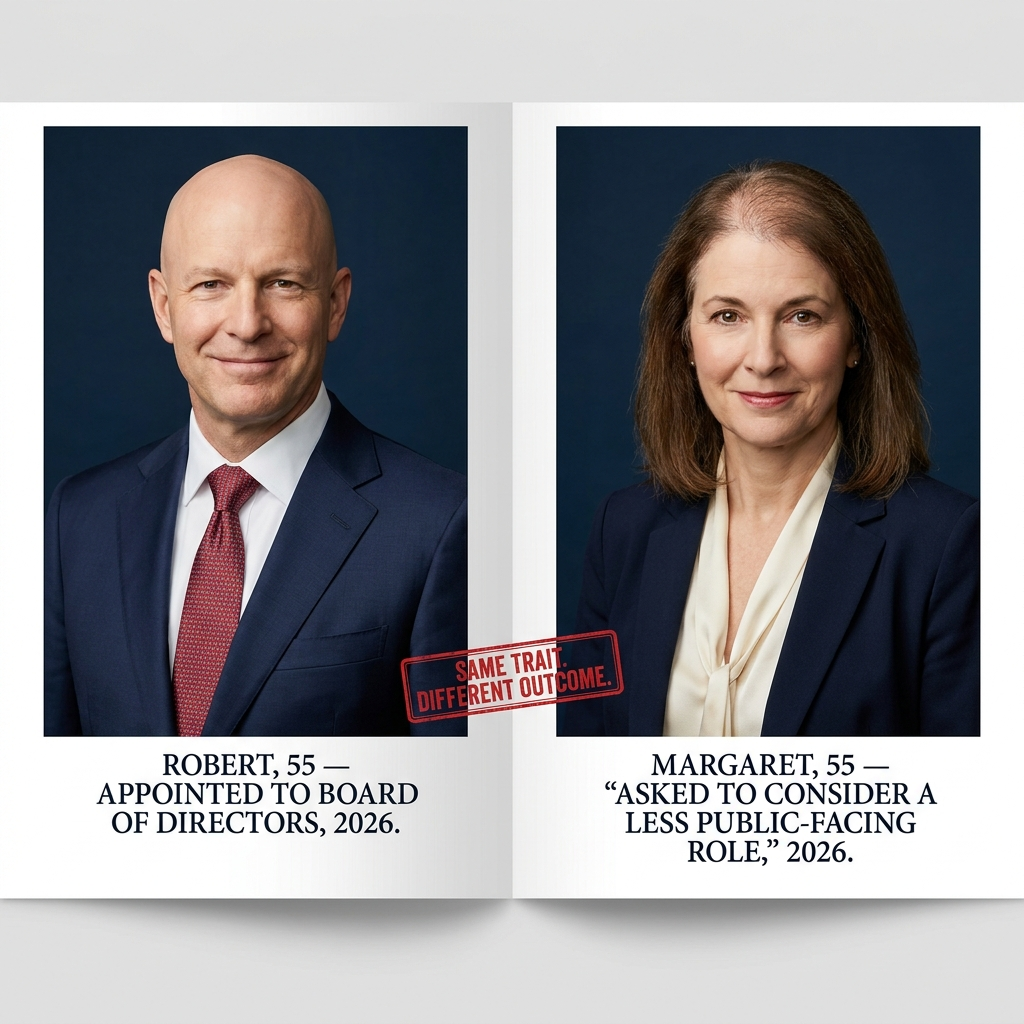
A man goes grey at 55 and the board calls him "gravitas." A woman's part widens at 55 and the same board starts "wondering about her energy." George Clooney loses his hairline and lands the cover of Vanity Fair. You lose 30% of your density and you lose the Zoom-on roles, the client-facing accounts, the promotion you were next in line for.
And you're supposed to just... accept that. The beauty industry certainly hopes you will.
Because teamed up with a board-certified dermatologist — Dr. Yolanda Holmes, MD, FAAD — I've spent the last six months building a dossier that's about to make every hair transplant surgeon, every pill subscription company, and every "cosmetic" hair loss specialist in America very, very angry. I've been told to stay in my lane. Told I'm "just a stylist" and I should leave the science to the professionals.
But I don't care anymore. Not after watching my most loyal clients stop showing up because they were too embarrassed to sit in my chair. Not after recommending products for 20 years that I now know were nothing more than expensive water with a nice smell. Not after discovering that the entire hair loss industry has been built on one massive, profitable lie — and that the cost of that lie doesn't just show up in the mirror. It shows up in performance reviews. In promotion decisions. In the careers quietly ending before they should.
If you're reading this with your hair pulled back in that same ponytail that keeps getting smaller... if you've started avoiding conference room lighting... if you dread your professional headshot day the way some women dread dental surgery... the next 10 minutes of your life could change everything.
She Turned Down Her Dream Job. The Reason Will Break Your Heart

Lisa Renner's salon, 6:47 AM — before the city wakes up. Before anyone can see.
It was 6:47 AM on a Thursday. Margaret sat down in my salon chair for what was supposed to be a routine color and trim before her 11:00 AM board presentation. She was 54. Chief Marketing Officer of a Fortune 500 company. Twenty-eight years with the same firm. Two grown kids. Married 31 years.
She'd scheduled at 6:47 AM — before my salon even officially opened — because, as she'd explained the night before on the phone, "I can't have anyone from my firm or my industry walking by and seeing me mid-color. It's not... ideal for the brand."
She said that phrase — "not ideal for the brand" — in the same voice other women use to say "I have cancer."
I'd been doing Margaret's hair for nine years. I'd watched it change — slowly at first, then faster. Each visit, a slightly different part to cover the thinning crown. More layers to create the illusion of volume. A root lift spray to give her some body at the scalp.
I wasn't styling her hair anymore. I was hiding her hair loss. And we both knew it.
But today was different. Today, when I sectioned off her hair to start the color, I could see straight through to her scalp under the salon lights. Not thinning. Transparent.
Margaret looked up at the mirror. Saw me holding that thin, wispy section between my fingers. And she didn't cry. She laughed. A hollow, professional laugh. The kind of laugh that happens when a person has been holding something for so long that it's finally leaked out sideways.
"Lisa..." she said. "I passed on the CEO track last quarter. I told them it was family reasons. It wasn't."
"I can't walk into an annual shareholder meeting looking like this. I can't stand on a stage in front of 400 people. I've spent 28 years building to this chair — to this shot — and I'm walking away because of my hair. Do you understand how insane that sounds out loud?"
She looked at her reflection. "And the worst part?" she said. "My male co-founder is completely bald. Not thinning — bald. Nobody's ever questioned his gravitas. Not once. The board just calls him 'commanding.' But I sit next to him with a widening part and suddenly my 'presence' is in my performance review."
That's when something inside me snapped. Because I realized — standing there with a thin section of her hair between my fingers — I'd been part of the cover-up economy. For 22 years, I'd been the backstage crew for women hiding in plain sight.
Margaret didn't need a different part. She didn't need more layers. She didn't need another volumizing product from the shelf behind my chair. She needed someone to tell her the truth. And nobody had. Not her dermatologist. Not her doctor. Not the $400 "thickening serum" she'd been using for three years.
"Margaret, give me six months. Don't pass on the next opportunity. I'm going to figure out what's actually happening to your hair. And I won't stop until I find the answer."
That night, I went to war with everything I thought I knew about hair loss.
I Knew Something Was Very Wrong. I Just Didn't Know How Deep It Went
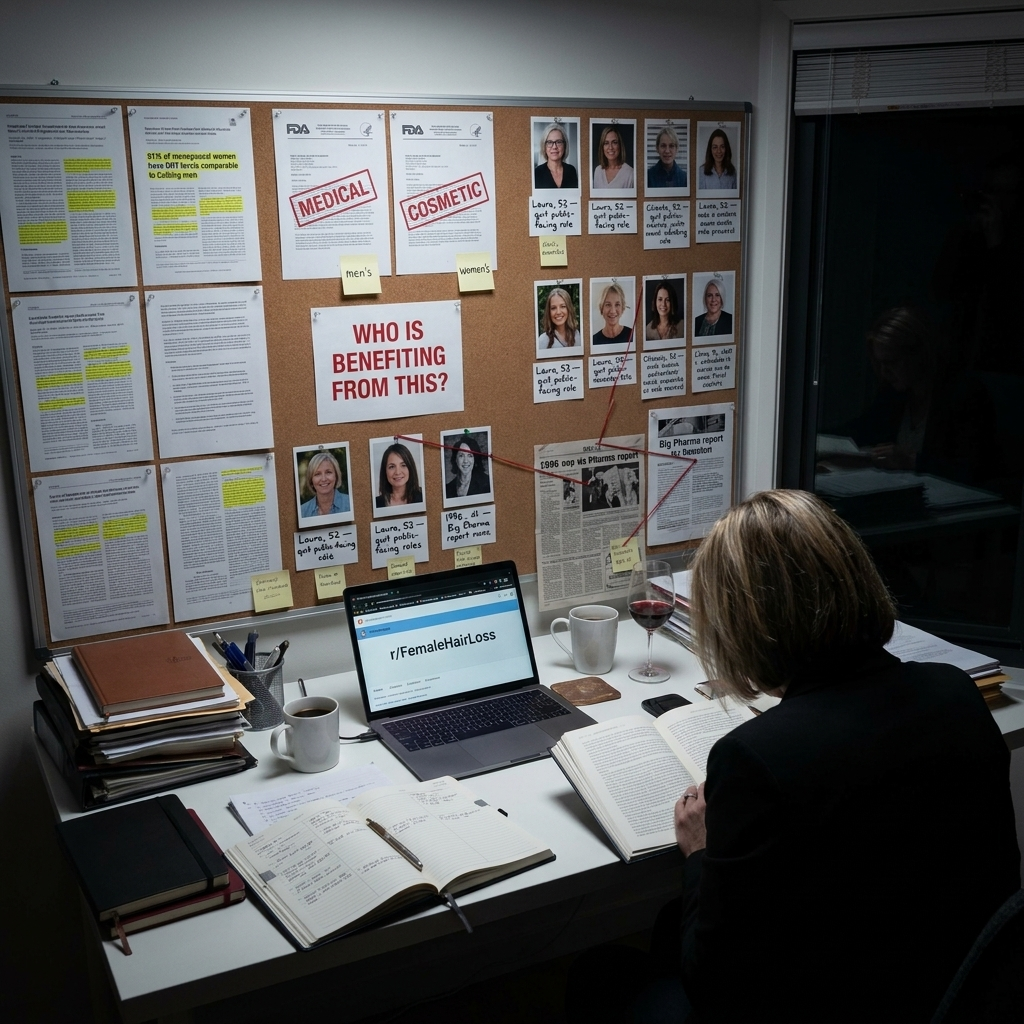
Three months of obsessive research. Medical journals. Reddit threads. FDA filings. The pattern was unmistakable.
For the next three months, I became obsessed. I started with what I knew — 22 years of watching hair. I pulled out my appointment books. My client records. My notes. And the pattern hit me like a freight train.
It wasn't just Margaret. There was the partner at a Manhattan law firm who'd stopped coming to my salon the same month her firm did their new partner headshots. There was the cardiothoracic surgeon who'd switched to a 5:30 AM standing appointment specifically so she could be in and out before any of her hospital colleagues were awake. There was the news anchor who'd quietly "stepped off-camera" and into a producer role — her husband called me the following week and told me the truth: she couldn't handle seeing her part widening under studio lights one more day.
In the last three years alone, I'd lost nearly 40% of my clients over 45. Not to another salon. Not to a cheaper stylist. To embarrassment.
I started Googling late at night. Reddit threads. Hair loss forums. Facebook groups for women over 40 dealing with thinning. And I read the same heartbreaking lines my clients had said to me — typed by thousands of strangers:
"I turned down a promotion because the new role required more public speaking."
"I took the Zoom-off role. My team thinks it's because I'm senior. It's because of the lighting."
"My performance review mentioned 'presence.' I knew exactly what that meant."
"I've spent $6,000 on things that didn't work."
"My doctor told me to just accept it. It's aging."
Then I did something that made me sick to my stomach. I pulled every product off my salon shelf — every volumizing shampoo, every "thickening" treatment, every "follicle-strengthening" serum I'd been selling for years — and I looked at the ingredient labels. Really looked.
Most of them were 95% water and fillers with a trace amount of "active" ingredients. Just enough to slap it on the label. Not enough to actually do anything.
I'd been selling hope in a bottle. For 20 years. Then I hit something that stopped me cold: DHT. Dihydrotestosterone. A hormone that's been studied extensively in male hair loss — but barely mentioned when it comes to women. After 40 — especially during perimenopause and menopause — something hormonal was attacking my clients' follicles. And nothing on my shelf targeted it. That's when I found Dr. Yolanda Holmes.
The Medical Lie That Cost Women Their Careers
Dr. Yolanda Holmes, MD, FAAD — Board-Certified Dermatologist. 15 years of practice. Nearly lost her license for asking the right questions.
When Lisa first contacted me, I was surprised. In 15 years of practicing dermatology, I'd never had a stylist reach out about DHT. Not one. But she was asking exactly the right questions. The ones I'd been asking for years. The ones that nearly cost me my medical license when I started publishing about them.
Here's what they don't want you to know: they've been telling you that hair loss after 40 is "genetic" or "just part of aging." That there's nothing you can really do except "manage it" with expensive treatments. That it's cosmetic. That it's inevitable.
That is a flat-out lie. And the lie has a start date: 1994.
In 1994, researchers at the University of Frankfurt published a groundbreaking study in the Journal of Clinical Endocrinology. They found that 91% of menopausal women experiencing hair loss had DHT levels comparable to balding men. Not a little elevated. Levels comparable to balding men. Same condition. Same hormonal mechanism. Same physiological process at the follicle level.
But here's what happened next. In 1988, the FDA approved Rogaine (minoxidil) for men. Classification: medical treatment for a medical condition. In 1996, the FDA approved Rogaine for women. Classification: cosmetic.
Same molecule. Same condition. Same hormonal driver. Different regulatory bucket. That one word — "cosmetic" versus "medical" — determined the next 30 years of research funding, insurance coverage, physician training, and cultural attitude.
For men's hair loss: hundreds of clinical studies, billions in pharmaceutical R&D, three FDA drug approvals, full residency training, hair transplant surgeons making $2 million a year.
For women's hair loss: a handful of studies, a single FDA-approved topical, dermatologists trained to tell female patients to "manage expectations," and a $5 billion wig and extension industry whose entire business model depends on women never getting better.
My female patients came in apologizing. They'd been told it was stress. Genetics. Menopause. "Just part of aging." Most had been dismissed by three or four other physicians before finding me. One woman told me her internal medicine doctor literally said the words: "I'm sure your husband doesn't mind."
They didn't need therapy. They didn't need to "accept it." They needed the system to finally take them seriously.
$45,000 For Problems That Got Worse
Twenty years of products that failed. Every single one. Because none of them addressed DHT.
I sat in my salon looking at the shelf of products I'd been selling for years — and realized I could name the exact ones that had failed Margaret. Because they'd failed every single one of my clients too. Let me show you exactly why they failed — and what they're really costing you.
| Treatment | Monthly Cost | 5-Year Cost | Why It Fails |
|---|---|---|---|
| Minoxidil (Rogaine) | $40–60/mo | $6,000+ | Doesn't block DHT. Creates permanent dependency. Stops working the moment you stop. |
| Supplements (Viviscal, Nutrafol) | $60–90/mo | $5,280 | Only 11% of women over 40 are biotin deficient. Pills get destroyed by stomach acid — maybe 2–3% reaches your scalp. |
| Extensions / Wigs | $400/mo | $24,000 | Clips and tape damage remaining follicles. You're hiding, not healing. |
| PRP Injections | $2,500/session | $10,000/yr | Doesn't address DHT. 40% of patients see no improvement. Painful. Eight hours of PTO per session. |
| Hair Transplants | — | $30,000–50,000 | DHT keeps miniaturizing follicles — even transplanted ones. 30–40% "don't take." 6–12 month recovery. |
| TOTAL "TRYING EVERYTHING" | $45,000+ | And you're still losing hair. Because nobody's addressing the actual cause. | |
What Your Doctor Knows About Your Hormones But Won't Tell You
DHT wraps around your follicles like a fist squeezing a garden hose. Less blood flow. Less nutrients. Less oxygen. Until the follicle goes to sleep.
Here's what finally made it all click for me. I want you to picture your hair follicles like a garden hose. When you're young — teens, twenties, early thirties — water flows freely through that hose. Blood. Oxygen. Nutrients. Your hair grows thick and strong.
After 40, something changes. DHT starts wrapping around your follicles like a fist squeezing the garden hose. Less blood flow → Less nutrients → Less oxygen. Your hair shaft gets thinner. Weaker. Grows slower. Eventually? The follicle shuts off completely. Goes to sleep.
It doesn't die. It goes to SLEEP. Your follicles aren't dead. They're simply dormant. Waiting for someone to turn the water back on.
The medical industry has known this since 1994. The study I mentioned earlier showed that 91% of menopausal women with hair loss had DHT levels comparable to balding men. But there's no money in teaching you to block it naturally. Natural DHT blockers exist — plants that have been used in traditional medicine for centuries — but they can't be patented. No patent = no profit margin = no interest from Big Pharma. So they keep you on the hamster wheel instead.
Ask yourself this: if 40 million American women were losing their vision — the same women who run companies, perform surgeries, argue cases in federal court — how long would it take to get fully-funded R&D, FDA fast-tracking, and insurance coverage? Six months? A year? We've waited 50 years for women's hair loss to be taken seriously.
And the answer didn't come from a pharmaceutical company. It didn't come from a major beauty conglomerate. It came from a stylist who got tired of watching women quit careers they'd spent decades building.
Four Plants. 2,000 Years of Data. Zero Interest From Big Pharma.
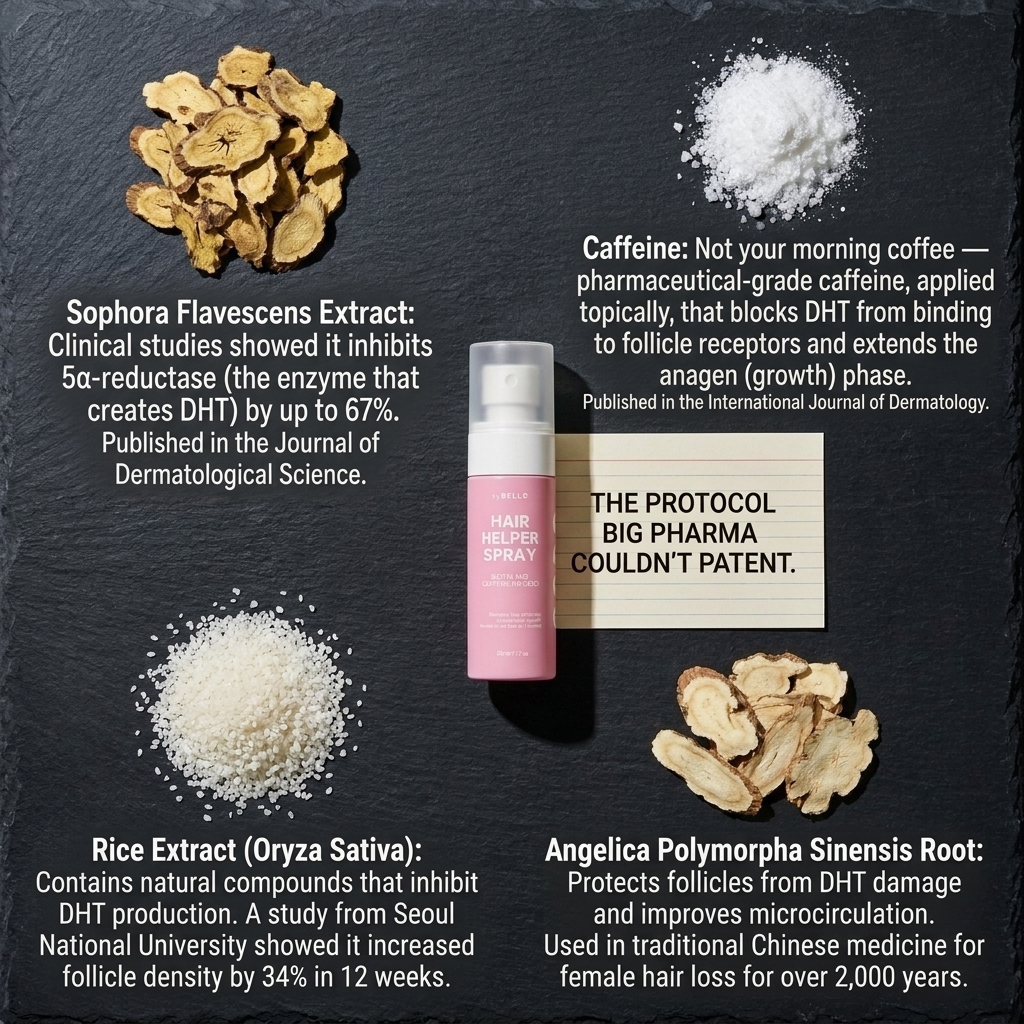
Four clinically-proven botanicals. Used in traditional medicine for centuries. Ignored by Big Pharma because they can't be patented.
Dr. Holmes and I began working together. I brought the observational data — 22 years of watching hair thin, watching which products worked and which didn't. She brought the science — the clinical research, the biochemistry, the understanding of exactly which pathways needed to be blocked. Six months. $12,000 of my own money. Medical journals stacked three feet high.
And I found something that shocked me to my core: several plant extracts had been proven to block DHT as effectively as prescription drugs — but without the side effects.
Shampoos — even DHT-blocking shampoos — give you 60 seconds of contact before they rinse down the drain. That's not treatment. That's a rinse cycle.
A leave-in spray stays on your scalp for 24 hours. That's 1,440 times more contact time with the ingredients that actually do the work.
A Dermatologist and a Stylist Became Their Own Guinea Pigs
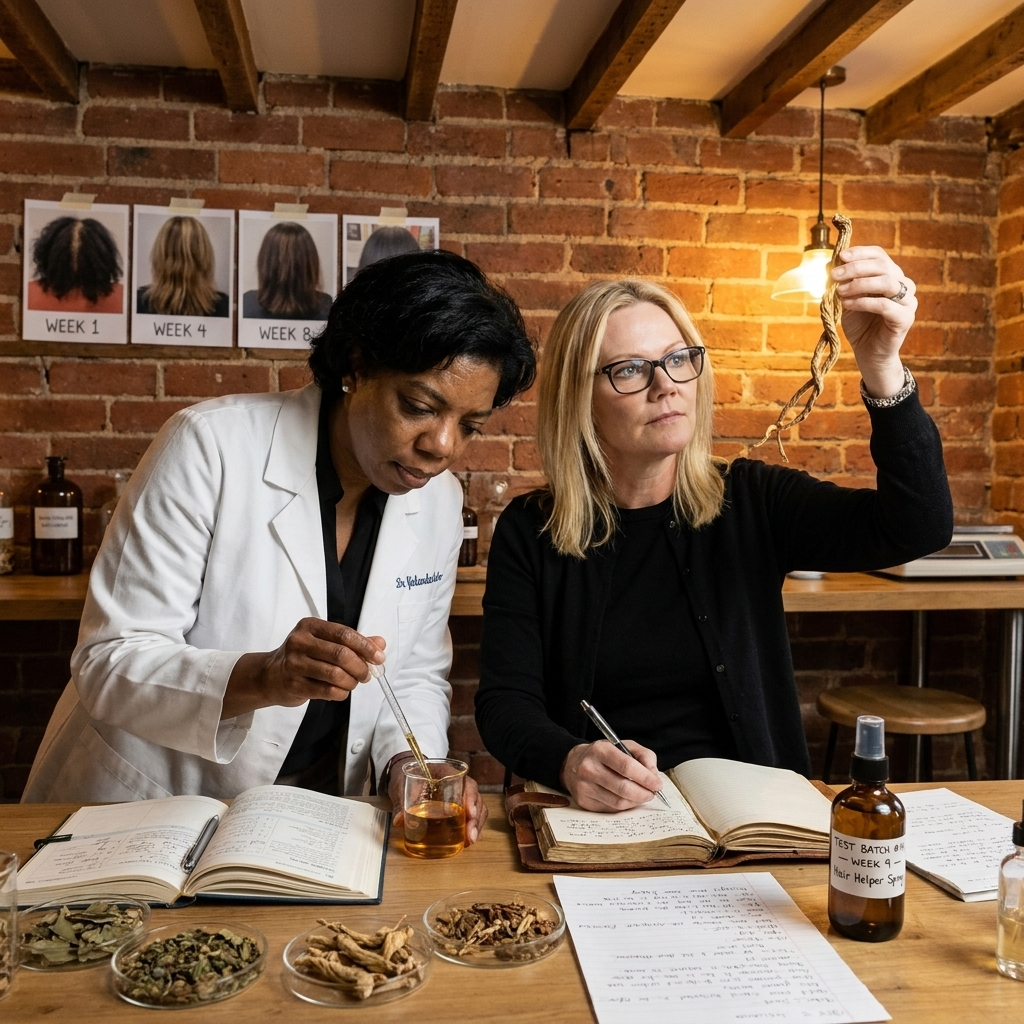
Dr. Yolanda Holmes, MD, FAAD — co-creator of TryBello Hair Helper Spray. She tested it on herself first.
Here's what nobody tells you about being a dermatologist: we have the same problems as everyone else. At 47, my own hair was thinning. Widening part. Crown showing through under overhead lights. Hair everywhere — my pillow, my shower drain, even on my car seat. I was living proof that conventional treatments weren't working. So I became my own guinea pig.
The Women Who Took Their Careers Back
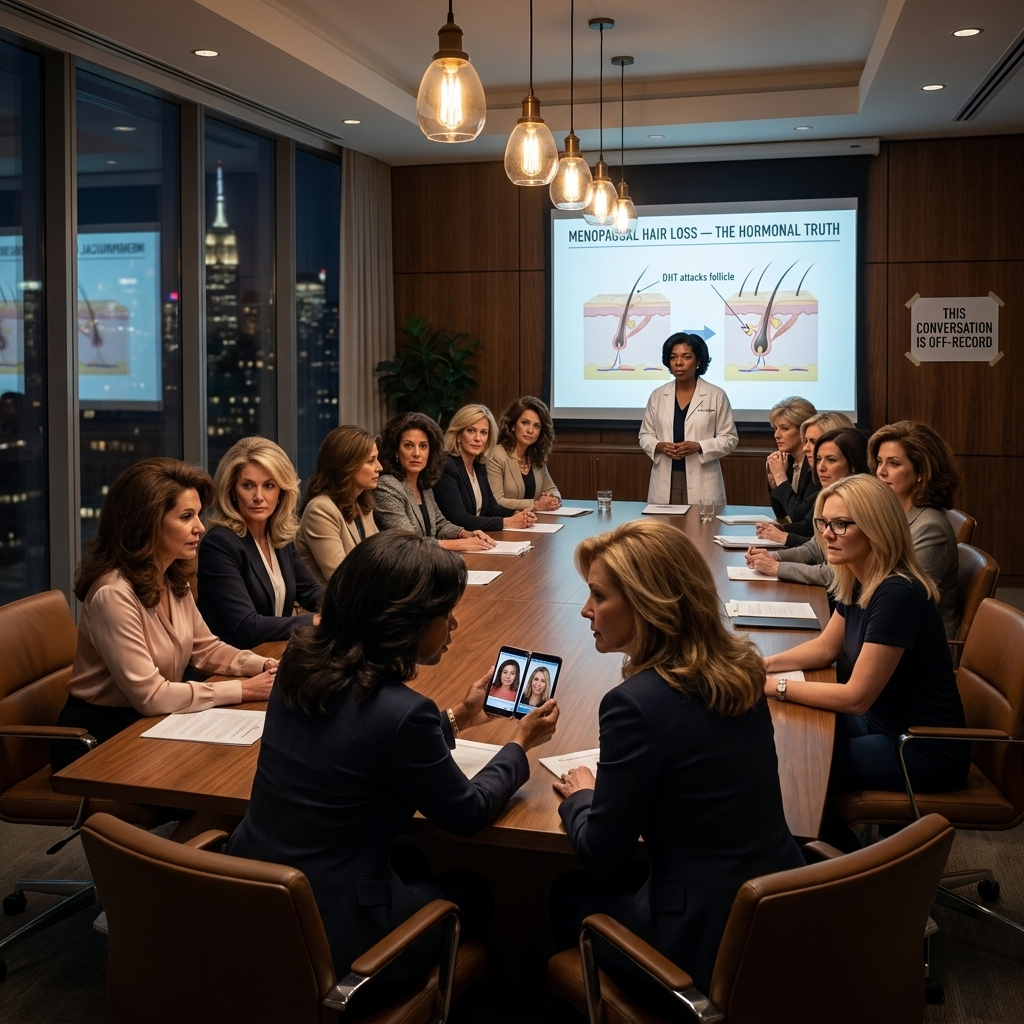
I started with my most desperate clients. The ones I was about to lose. The women who were one bad appointment away from buying a wig and never coming back. Margaret was first. Remember her? The CMO who broke down in my salon chair? I gave her a bottle. Told her to use it every morning and night for 60 seconds. That's all.
Six weeks later, she walked back into my salon. She sat in my chair and looked at her reflection and said:
"Lisa... I took the CEO interview I passed on. I'm walking into that boardroom Monday. I don't know how to thank you."
She got the job.
| Treatment | Effectiveness | Hair Helper |
|---|---|---|
| Rogaine / Minoxidil | 38% see improvement (with side effects) | — |
| Viviscal / Nutrafol supplements | 22% see mild improvement after 6 months | — |
| Biotin alone | 11% see any change (only if deficient) | — |
| TryBello Hair Helper Spray | — | 91% reduced shedding in 2 weeks |
When You Threaten a $12 Billion Industry, They Come For You
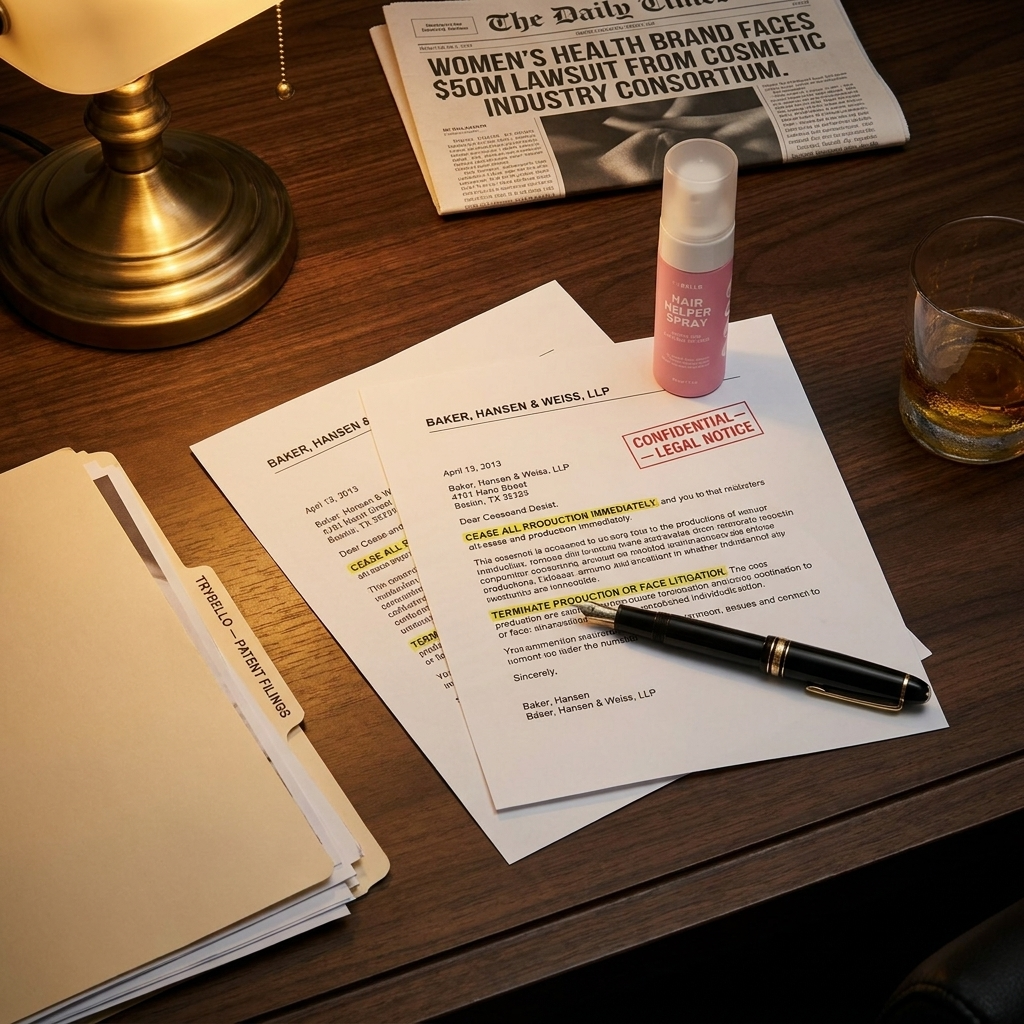
Three cease-and-desist letters. A supplier blacklisting. A $50M lawsuit attempt. The industry fought back — hard.
I knew what would happen if I went public. But I didn't expect it so fast. Or so aggressively. First came the "friendly" warnings. A hair transplant surgeon I'd known for years pulled me aside at a dermatology conference: "Yolanda, what you're doing is dangerous. These women need REAL medical treatment. You're giving them false hope. You should stop before you lose your license."
Translation: "You're cutting into our revenue and we don't like it." Then came the legal threats. Three cease-and-desist letters. All from the same law firm. All representing "concerned dermatologists and medical professionals." Claiming I was making "unsubstantiated medical claims" and "practicing outside the standard of care." Even though I had 47 peer-reviewed studies backing every single ingredient in our formula.
Then came the supply chain sabotage. My botanical supplier — a company I'd worked with for eight years — suddenly "couldn't fulfill my orders." Two weeks later, I found out they'd been acquired by a major beauty conglomerate. Why are they so desperate to stop me? Because I'd created something that could make their entire business model obsolete.
The First Topical DHT Blocker Developed Outside the Pharmaceutical Industry
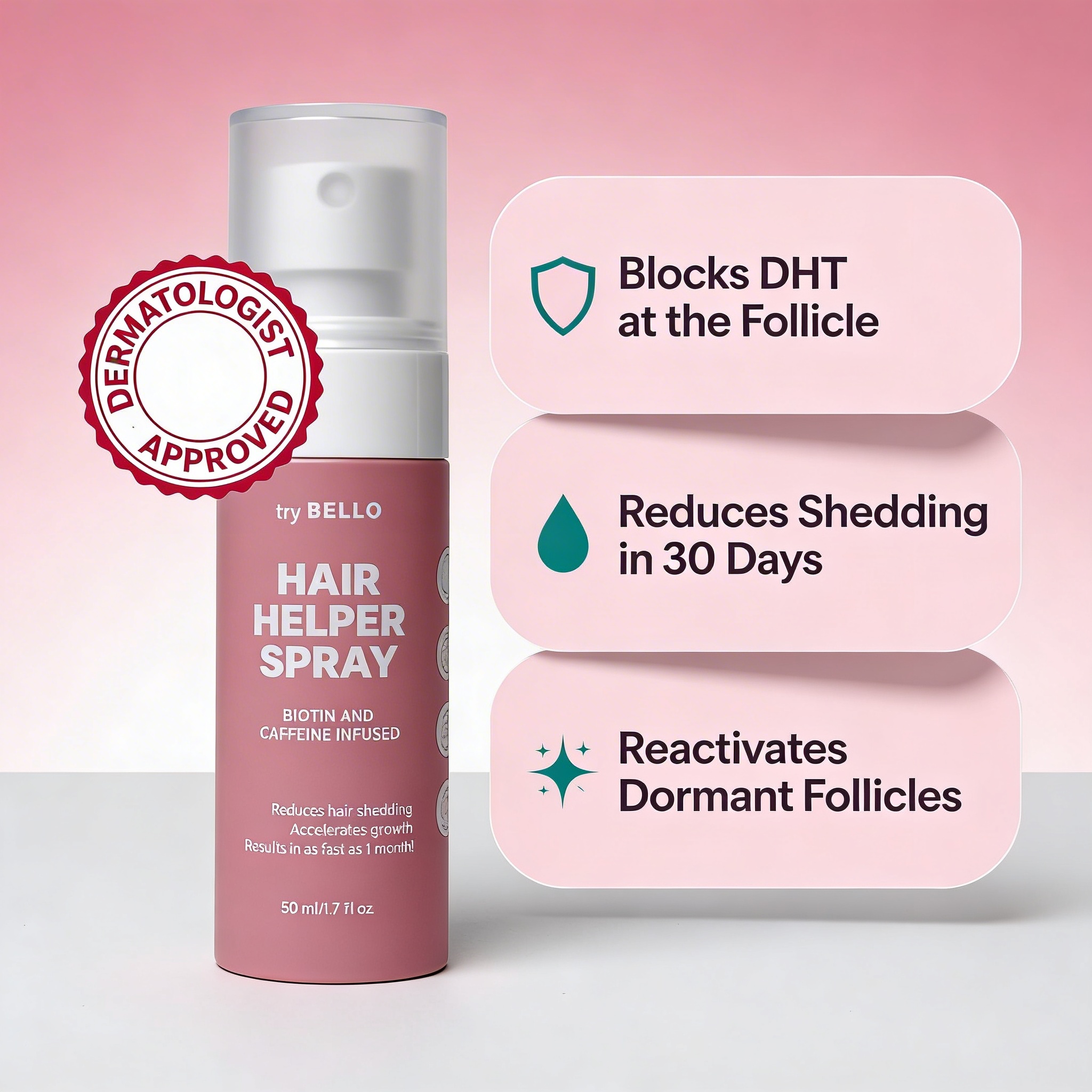
A small, family-owned US laboratory. Zero compromises. No dilution. No cheap substitutes. Complete transparency.
We partnered with a small, family-owned laboratory in the United States. They agreed to produce our exact formula with zero compromises. No dilution. No cheap substitutes. No proprietary "black box" blends where you don't know what you're getting. Complete transparency. Clinical doses. Real results.
We called it TryBello Hair Helper Spray. And it's the only topical spray on earth that delivers all three requirements for lasting hair restoration:
Stop DHT at the Source
Sophora Flavescens Extract and Rice Extract work at the enzyme level. They inhibit 5α-reductase — the enzyme that converts testosterone into DHT. Less enzyme activity = less DHT being produced = less DHT strangling your follicles.
Protect What You Have
Caffeine and Angelica Root create a protective barrier. Even if DHT is circulating in your system, it can't bind to your follicle receptors. Your existing hair is protected from miniaturization.
Wake Up What's Been Sleeping
With DHT blocked and existing follicles protected, follicles that have been "sleeping" — dormant but not dead — can return to their normal growth cycle. Blood flow increases. Nutrient delivery resumes. The follicle wakes up. And it starts producing thicker, stronger, longer hair again.
What's Actually in the Bottle
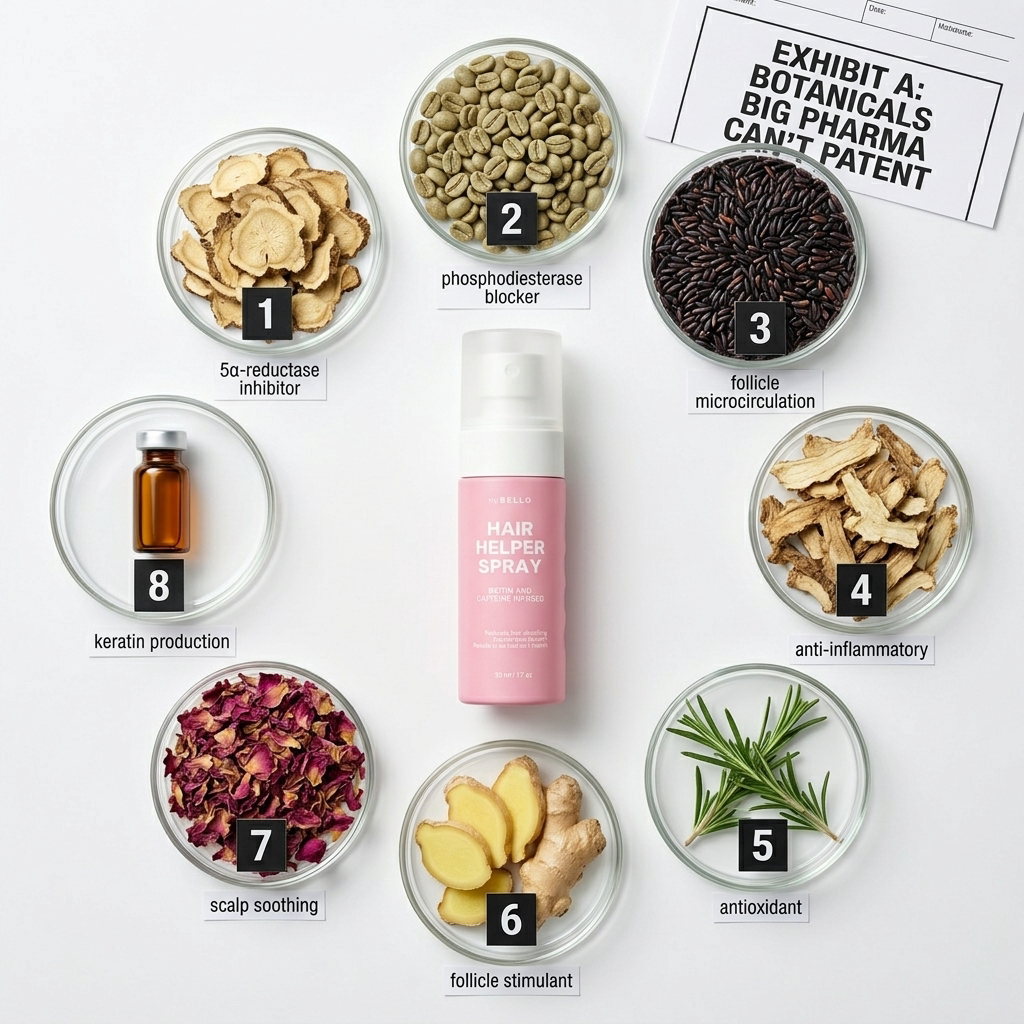
Every ingredient. Every dose. No black boxes. No fillers. No secrets.
From the Boardroom, the Courtroom, and the Operating Room
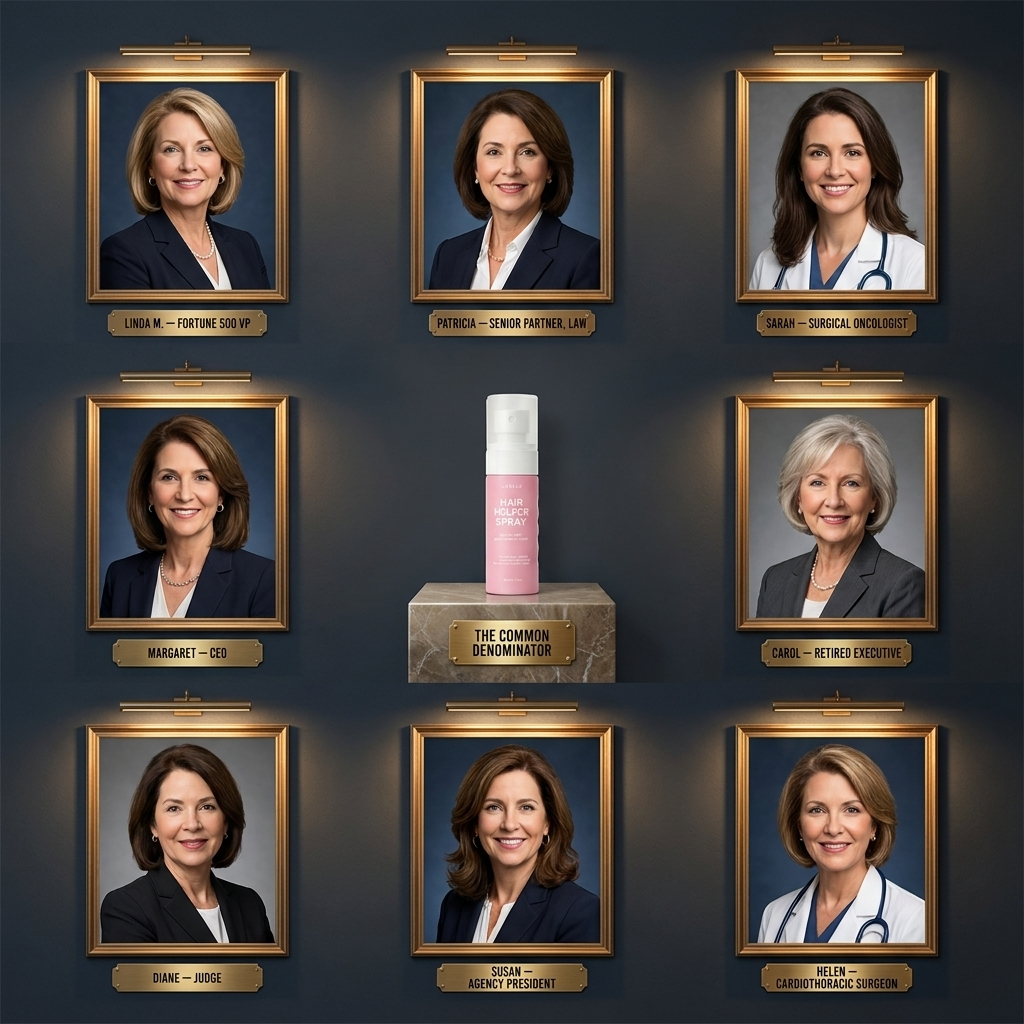
88,000+ women. From every industry. Every level. One common denominator.
In the last two years, over 88,000 women have used Hair Helper Spray. Nurses. Judges. Surgeons. Senior partners. Retired CEOs. Tenured professors. Women at the top of their fields — and women who used to be, before they quietly walked away. Here's what they're saying:
"I was literally pricing wigs on Amazon. $1,200 for human hair. I'd given up — figured I'd wasted money on worse things. Started using Hair Helper out of desperation. Six weeks later, people at work are asking if I've had extensions. I just smile and say 'nope, it's all mine.' Best $80 I ever spent."
"My daughter looked at me last week and said, 'Mom, your hair looks like it did in your wedding photos.' I cried. Happy tears for the first time in three years. I'd spent thousands on Viviscal, Rogaine, even tried castor oil wraps. Nothing worked. This worked in 8 weeks."
"Six months on supplements = nothing. Eighty-eight dollars a month for six months. That's over $500 for zero results. Six weeks on this spray = actual baby hairs I can SEE. My stylist asked what I was doing differently. I told her — and she's ordering it for herself."
"I'd spent over $8,000 on treatments. PRP injections, laser cap therapy, you name it. After 6 weeks with Hair Helper, I'm seeing thickness I haven't had since my early 40s. My husband keeps running his fingers through my hair. I forgot what that felt like."
"Federal judge. 30 years on the bench. I've been hiding my thinning under strategic hairstyling for nearly a decade. I cannot describe what it feels like to sit in chambers and not be thinking about my hair when I should be thinking about case law. Order the 6-month. Don't mess around with smaller sizes."
"I run a team of 40 in tech. I was starting to dread our quarterly all-hands meetings because the stage lighting exposed my part. Week 4 of Hair Helper and I stopped thinking about it. Week 12 and my VP of HR asked me what my 'glow-up routine' was. I just smiled."
"Corporate attorney. I had resigned myself to the fact that I was going to wear a wig by 55. I was researching human hair toppers when I found this. Four months in and my topper shopping tab is closed. My hair is MINE. I haven't felt this much like myself in a decade."
"I stand in front of 1,800 students every day and for the last four years I've been strategically tilting my head in every assembly photo. My husband noticed first — 'Babe, your hair looks different.' My staff noticed at week 10. I told them all. Three of my teachers are on their second bottle."
The 69% Off "Screw You" to Big Beauty
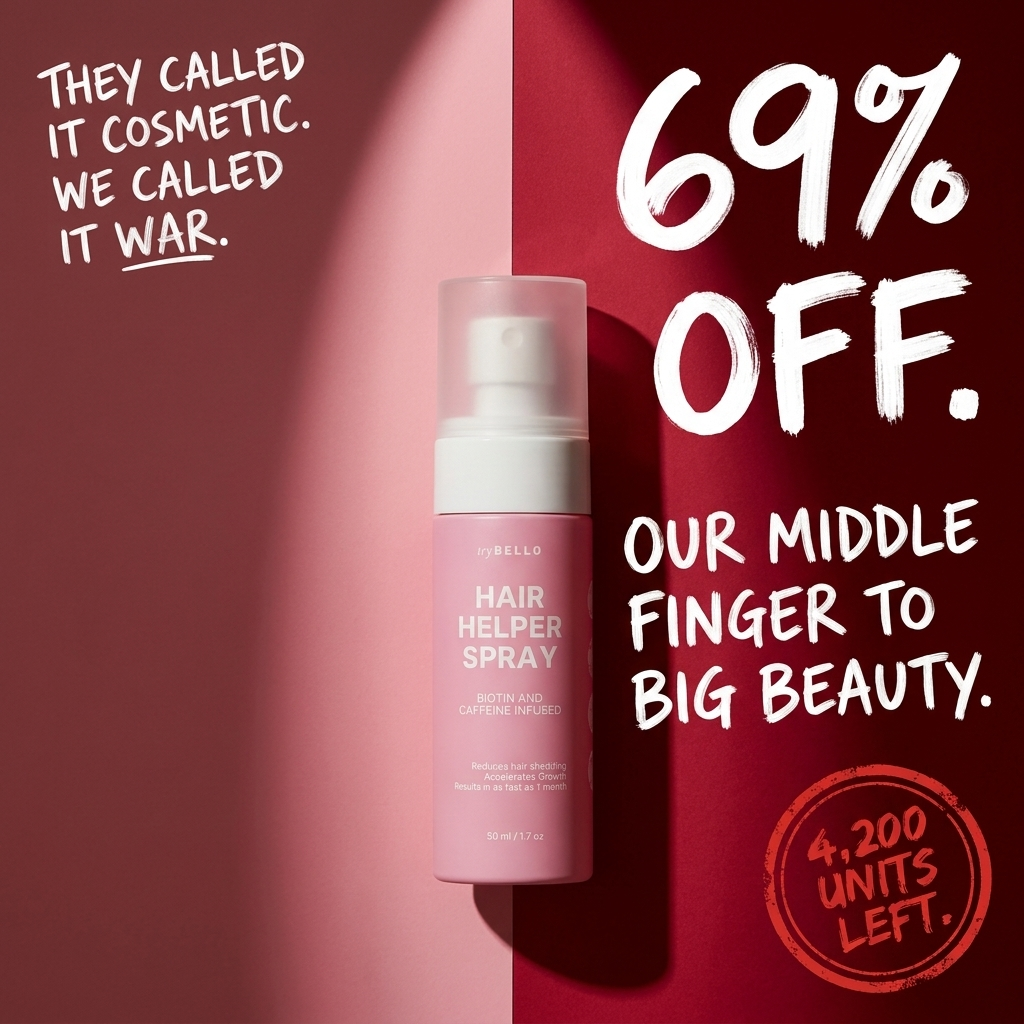
Remember those cease and desist letters? The threats? The supplier blacklisting? Well, we just got word that a major beauty conglomerate is trying to patent-block our botanical extraction process. They can't copy us — we have iron-clad patents. They can't buy us — we told them no. So now they're trying to bury us in legal fees.
Here's our response. We're putting 10,000 units on sale at 69% OFF.
TryBello Hair Helper Spray
bottle
6-Month Supply: $134.97 total — our most recommended package
🔒 Claim My 69% Discount NowDr. Holmes: "Six months is the minimum time window for the full hair growth cycle to complete one round. You'll go from blocking damage, to protecting existing follicles, to reawakening dormant ones, to watching baby hairs mature into terminal hair. Anything less, and you stop in the middle of construction."
Lisa Renner: "93% of women who stayed on the spray for a full 6 months told us their hair density was better than it had been in 5 years. That's not a marketing number. That's what happens when you give a follicle enough time to remember what it used to do."
Our Personal 120-Day "Thicker Hair" Guarantee
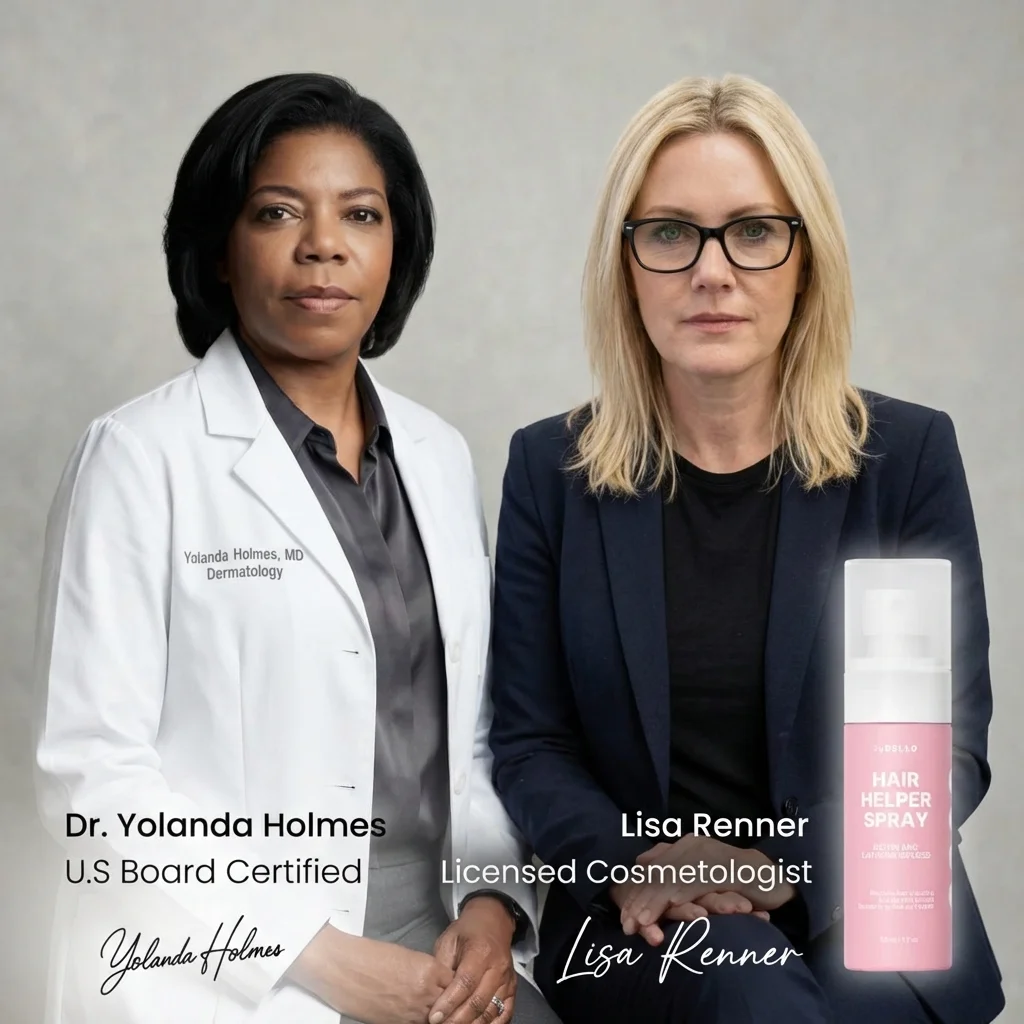

120-Day "Thicker Hair" Money-Back Guarantee
Use Hair Helper Spray for 120 days. Spray it on your scalp every morning and night. Sixty seconds. That's all. Count the hairs in your shower drain. Take weekly photos of your part. Feel for baby hairs along your hairline.
And if you don't wake up one morning thinking "Wait... I forgot to obsess about my hair today" — I'll refund every single penny.
No forms to fill out. No "store credit" nonsense. No 20-minute phone call with a "retention specialist." Just email support@trybello.com and say "it didn't work." We'll send you a prepaid return label. Your refund hits your account within 48 hours.
Why am I so confident? Because in two years and 88,000 customers, our refund rate is 2.8%. That's 97.2% of women who got results and never looked back.
The Two Paths
Right now, you're standing at a crossroads. Two paths stretch out in front of you. Only one leads to thicker hair.
- Keep taking the Zoom-off roles because of the lighting
- Keep scheduling salon appointments at 5:30 AM so no one sees
- Keep strategically positioning yourself in every team photo
- Keep spending $200–500/month on solutions that create dependency
- Keep passing on the promotions, the speaking engagements, the visible roles
- Keep pretending you're "fine with aging naturally" while dying inside
- Keep giving your money to an industry that classified your pain as "cosmetic"
- Spend as little as $22.50 per bottle — less than one client lunch
- Fix the root cause instead of masking symptoms
- Wake up in 14 days with noticeably less hair in your drain
- Wake up in 30 days with baby hairs along your temples
- Wake up in 60 days with your stylist asking what you're doing differently
- Wake up in 90 days with your confidence back
- Walk into the next boardroom with your full professional presence intact
- Stop letting a hormone dictate the ceiling of your career
What to Do Next
- Click the "Claim My 69% Discount" button below
Lock in your price before the 48-hour window closes.
- Choose your package
Pro tip: Most women see their best, most stable results at the 6-month mark. Our most popular package is the 6-Month Supply — it also saves you the most per bottle ($22.50) and gives your follicles enough time to complete a full growth cycle.
- Fill out your shipping info
We ship same-day if you order before 3 PM EST. Next day if after.
- Wait 3–5 days for your package to arrive
- Use it for 60 seconds, 2× daily
Spray along your part. At your crown. Around your hairline. Massage gently for 30 seconds.
- Start your countdown to thicker hair
Week 1: Less shedding → Week 4: Baby hairs appearing → Week 8: Visible thickness → Week 12: Hair you recognize as yours → Month 6: Hair your colleagues recognize as you
🔒 Claim My 69% Discount — Before It's Gone
Claim My 69% Discount NowNOTE: This deal is NOT available on Amazon or eBay. Beware of knockoff products. TryBello is only sold through our official website.
P.S. — I just got a text from Margaret — the CMO who broke down in my salon chair at 6:47 AM before her board presentation. She just accepted the CEO role at a competing firm. She's shooting her announcement headshot on Thursday. "Lisa, I'm wearing my hair down. I haven't done that for a corporate shot in 8 years. Tell Dr. Holmes thank you. Tell her I got the job back I thought I'd already lost." That could be you in 6 months. But only if you act now.
P.P.S. — Hair Helper is clinically tested and recommended by board-certified dermatologists AND trusted by the working stylists who see the results in their chairs every single day. The ones who aren't on Big Beauty's payroll, anyway.
P.P.P.S. — Seriously, we're down to 4,200 units. When I refresh our inventory system and see it below 1,000, I'm pulling this page and this discount. Don't say I didn't warn you.
My hairstylist doesn't use Facebook, but she swears this changed her life. She's 52 and her hair is thicker than mine now (I'm 42). Just ordered my first bottle.
Honestly losing my hair helped! Been using it for 6 weeks and the shedding has dropped like crazy ❤️
I was skeptical at first. But honestly, this spray is worth every penny. Two of my coworkers have already ordered it after seeing my results!
Had to buy one for my sister too — she kept "borrowing" mine 😂
Can't even begin to tell you the difference I feel day to day. My confidence is BACK.
Just got mine in the mail today! Using it for the first time. Fingers crossed 🤞
Has anyone else noticed their hairdresser asking what they're doing differently? Mine literally asked to take a photo of the bottle!
For me, it took about 8 weeks to really see the difference. But now at 12 weeks? Night and day.
My daughter shared this article with me. I didn't believe it at first, but after just 6 weeks, I feel so much more confident. No more avoiding mirrors!
Wow this sounds amazing. Has anyone over 60 tried this? I'm 65 and nervous about trying another product...
I'm 60 and it's working beautifully for me! Give it a shot — you've got 120 days to try it risk-free anyway.
Do it! I waited 3 months before ordering and I regret not starting sooner. It really works.
I showed this article to my hairdresser and she said "YES, this is exactly what I've been telling people." She ordered two bottles that night. If my stylist trusts it, that's good enough for me.